Justice Without Redistribution: Lessons from South Africa for Bangladesh
By Khandaker A. Raquib
In his essay “Beyond Nuremberg: The Historical Significance of the Post-Apartheid Transition in South Africa”, Mahmood Mamdani argues that South Africa’s Truth and Reconciliation Commission (TRC) presented a radically different model of justice from the Nuremberg Trials.
At Nuremberg, what prevailed was “victor’s justice.” The defeated Nazis were punished by the victors. In South Africa, however, there was neither a decisive victory nor a total defeat. The white ruling elite, under pressure, negotiated a transfer of power rather than being overthrown. What unfolded was not regime overthrow but reform through political compromise. As a result, the TRC emerged as a unique model: one that enabled political inclusion, yet left the entrenched economic and social structures intact.
Mamdani points out that both Nuremberg and the TRC shared one crucial feature: they reduced crimes to individual responsibility. But apartheid was not merely a matter of individual abuses; it was a legal and institutional system of domination. Its violence lay in the everyday realities of administrative repression, land dispossession, forced removals, and economic exclusion. Yet the TRC only recognized “gross human rights violations”: killings, torture, disappearances, while ignoring the broader structural violence endured by the black majority. This created a hierarchy of victims: a few were acknowledged, while the suffering of the many was rendered invisible. Meanwhile, the privileges and power of the white elite remained largely untouched.
Most crucially, the TRC brought reconciliation but not redistribution. There was no land reform, no dismantling of deep-rooted economic inequalities. White economic power remained almost intact. Mamdani contrasts this with other postcolonial contexts, such as Algeria and Zimbabwe, where violent revolutions, however authoritarian their outcomes, did at least bring about redistribution of resources. South Africa took a different path: it achieved political democracy through nonviolent negotiation, but without altering its economic foundations.
Bangladesh and the Question of Negotiated Justice
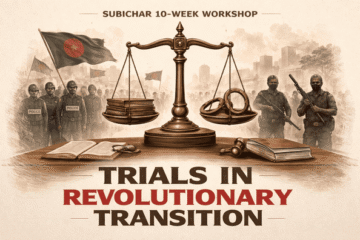
These debates resonate with Bangladesh’s present-day International Crimes Tribunal (ICT) for crimes against humanity. This is not a revolutionary tribunal that transforms the state or triggers social and economic restructuring. Rather, it too is a form of negotiated justice.
On one side are the pressures from victims’ families, segments of revolutionary student activists, and parts of civil society. On the other side stand powerful state institutions and entrenched elites. Within this negotiation, the trials have focused overwhelmingly on individual criminal responsibility, while sidestepping the larger questions of state structures and political accountability.
The implicit narrative becomes one of “bad apples” – a few rogue leaders or officers committed the crimes, while the political system itself remained intact and legitimate. The old political settlement endures, even as individuals are punished.
In Mamdani’s terms, Bangladesh too presents a complex blend of “justice” and “politics.” Justice has been partially realized – families see some recognition of their suffering, and perpetrators face the law. Yet the deeper issues of structural violence, inequality, and systemic impunity remain unaddressed.
Conclusion
The lesson from South Africa, as Mamdani shows, is that reconciliation without redistribution leaves the foundations of injustice untouched. Bangladesh’s war crimes trials have made important strides, but until justice expands beyond individuals to interrogate institutions and dismantle structures of inequality, it risks reproducing the same paradox: a performance of accountability without transformation.