The article was first published in the Deltagram on Saturday, 31 January 2026.
What the Chankharpul judgment gets right and what it leaves unresolved
The verdict advances accountability upward, but raises questions about attributing responsibility for the perpetrators.
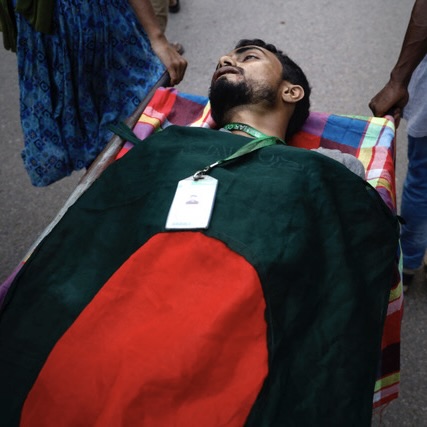
Representative photograph. Violating curfew may constitute a legal offence, but it does not transform civilians into combatants. Photo: AFP
The first verdict in a case against members of Bangladesh’s security forces for crimes against humanity was delivered, holding six officers criminally responsible for the killing of civilians.
At the centre of the case lies the incident of 5 August 2024 at Chankharpul, Dhaka, during the July Movement. The Tribunal accepts as proven that students and civilians from across the country were marching toward Dhaka to participate in the “March to Dhaka” programme at the Central Shahid Minar.
According to the judgment, protesters were halted near the Chankharpul area and then fired upon with lethal weapons. Six unarmed civilians were killed, and many more were severely injured. The court sentenced former DMP Commissioner Habib Rahman, Joint Commissioner Sudip Kumar Chakraborty, and Additional Deputy Commissioner Shah Alam Md Akhtar ul Islam to death, imposed six years’ imprisonment on Assistant Commissioner Mohammad Imrul, four years on Inspector Md Arshad Hossain, and three years’ imprisonment on three lower-rank constables who fired, citing extenuating circumstances.
The judgment delivered in this case will likely shape Bangladesh’s legal treatment of mass political violence for years to come. Its influence will extend far beyond the fate of the accused in this single case. By establishing a particular way of understanding command, coercion, and responsibility, the verdict opens a pathway that may significantly affect how subordinate officers and soldiers are judged in future prosecutions for crimes against humanity.
In that sense, the ruling is both groundbreaking and troubling, expansive in its ambition yet uncertain in its consequences.
Video evidence showing Sujan firing and appearing to rejoice is addressed directly. Rather than ignoring this, Justice Mortuza confronts it and offers a moral explanation
The court’s observations on state violence are among the most forceful ever articulated in a Bangladeshi tribunal. At the same time, the reasoning used to mitigate the responsibility of lower-ranking perpetrators may unintentionally create a durable framework for partial immunity. What emerges is not a simple story of justice achieved or denied, but a deeper struggle over how violence carried out through institutions should be named, attributed, and punished.
One of the most consequential aspects of the judgment lies in its reasoning of the violence as premeditated rather than reactive. The judgment begins not at the street level, but at the level of nightly “core committee meetings” held at the residence of the then Home Minister Asaduzzaman Khan Kamal. These meetings are described as spaces where illegal strategies were devised to suppress the July Movement and eliminate civilian protesters by a range of politicians and high-ranking security officials. This framing is important because it shifts the narrative away from crowd dynamics and toward political decision-making. The killings at Chankharpul are not treated as isolated acts of panic or misjudgment. They are presented as the execution of a broader strategy, conceived in advance and implemented through institutional channels.
Another consequential aspect of the judgment lies in its rejection of the defence’s central justification for lethal force during curfew. The court acknowledges that a government-imposed curfew was in effect on 5 August 2024. It does not dispute the state’s authority to declare emergencies or to deploy police and security forces to maintain public order. Indeed, the judgment explicitly affirms that the presence of law enforcement personnel at key locations during curfew was not, in itself, unlawful. Maintaining order and protecting life and property are legitimate state functions, even in moments of crisis.
But the court draws a firm and uncompromising boundary. Curfew, it holds, does not annul civilian status. Nor does it authorise the use of lethal force against unarmed people. This distinction is not merely technical. It restores a moral clarity that emergency governance often obscures. Violating curfew may constitute a legal offence, but it does not transform civilians into combatants. It does not strip them of protection, and it does not justify killing.
In highlighting the individual role, the Tribunal draws a clear hierarchy of responsibility
In articulating this boundary, the court reframes curfew not as a zone of suspended ethics but as a test of restraint. Emergency powers do not reduce the state’s responsibility toward civilian life; they intensify it. The judgment insists that the value of civilian life does not diminish when the state feels threatened. On the contrary, it becomes the very measure by which the legitimacy of state action must be judged.
The court’s analysis of the Chankharpul killings flows directly from this premise. The protesters, it finds, were students and ordinary citizens from diverse social backgrounds, moving toward the Central Shaheed Minar as part of a mass political mobilisation. They were unarmed. They were not engaged in violence. Their movement may have violated curfew restrictions, but that violation alone did not justify the use of lethal weapons. The deaths that followed were therefore not tragic accidents or collateral damage. They were crimes.
In highlighting the individual role, the Tribunal draws a clear hierarchy of responsibility. At the top stands Habib Rahman, Commissioner of Dhaka Metropolitan Police, who is found to have issued wireless orders directing subordinates to open fire with lethal weapons and to have monitored operations to instil fear among the public. Sudip Kumar Chakraborty, Joint Commissioner, is attributed an even starker role. According to the judgment, he ordered police not only to shoot and kill but also to leave bodies in streets and lanes so that protesters could not advance. This detail becomes central to the Tribunal’s understanding of intent where killing was meant to be visible, pedagogical, and deterrent.
Below them, Additional Deputy Commissioner Shah Alam Md Akhtar ul Islam and Assistant Commissioner Mohammad Imrul are found to have exercised on-site supervision at Sankarpur. Their role bridges planning and execution. They are portrayed as ensuring that orders were carried out on the ground, including by compelling subordinates to fire.
Inspector Md Ashrad Hussain is found to have directly instructed police personnel at Chankharpul to fire indiscriminately. At the lowest level, Constables Sujan Hussain, Imaz Hussain Iman, and Md. Nasirul Islam are identified as having opened fire between 12:30 and 1:00 pm, resulting in the deaths of six protesters.
Perhaps the most nuanced part of the judgment lies in its treatment of subordinate police personnel. The Tribunal finds that some officers refused to fire and were threatened and verbally abused. Constable Sujan Hussain, in particular, is described as having been issued only a shield and lathi and later forcibly handed a Chinese rifle and ammunition taken from another constable.
Video evidence showing Sujan firing and appearing to rejoice is addressed directly. Rather than ignoring this, Justice Mortuza confronts it and offers a moral explanation: Sujan had joined service only months earlier and acted under coercion and command pressure. Had he not been forcibly armed, the Tribunal reasons, he would not have fired and would not have faced punishment. In this way, the judgment distinguishes between legal guilt and moral origin, treating lower-rank shooters as both perpetrators and victims of institutional command.
On the evidentiary dimensions of the case, Justice Mortuza also offered a careful and consequential reading of the prosecution’s evidence. Addressing the uncertainty surrounding ballistic reports, the court openly acknowledged that it was not possible to determine which bullet killed which victim. Rather than treating this limitation as a weakness, however, the tribunal deemed it irrelevant. In cases of crimes against humanity, the court held, participation in a widespread and systematic attack is sufficient.
The law does not require, in every instance of death, precise ballistic proof identifying whose bullet struck whom. Through this reasoning, the tribunal aligned domestic legal standards with international criminal jurisprudence and shifted the focus from isolated individual acts to responsibility for organised violence. Notably, the prosecution’s case rested on testimony from 26 witnesses, supported by audiovisual materials, medical records, wireless transcripts, reports from the United Nations, and documentation from Odhikar. By contrast, the defense presented only three witnesses. The tribunal explicitly noted that cross-examination failed to reveal any material or substantial inconsistencies in the prosecution’s evidence.
Perhaps the most nuanced part of the judgment lies in its treatment of subordinate police personnel. The Tribunal finds that some officers refused to fire and were threatened and verbally abused. Constable Sujan Hussain, in particular, is described as having been issued only a shield and lathi and later forcibly handed a Chinese rifle and ammunition taken from another constable.
It recognises that lower-ranking personnel operate within structures that constrain choice and produce obedience
Video evidence showing Sujan firing and appearing to rejoice is addressed directly. Rather than ignoring this, Justice Mortuza confronts it and offers a moral explanation: Sujan had joined service only months earlier and acted under coercion and command pressure. Had he not been forcibly armed, the Tribunal reasons, he would not have fired and would not have faced punishment. In drawing this distinction, the judgment attempts to separate legal culpability from moral origin, action from agency. It recognises that lower-ranking personnel operate within structures that constrain choice and produce obedience. But in reducing even visible expressions of enthusiasm to command pressure, the court may create a precedent with far-reaching implications.
If coercion and hierarchy are sufficient to substantially mitigate responsibility even where there is direct participation and apparent enjoyment, then future cases involving enforced disappearances, extrajudicial killings, and mass repression may see large numbers of subordinate officers invoke similar claims. It also raises a question: how far down does responsibility meaningfully extend?
The Chankharpul verdict stands as both a landmark and a warning. It offers one of the clearest judicial articulations yet of how state violence is planned, authorised, and executed. It decisively rejects curfew as a justification for killing and reasserts the inviolability of civilian life. But it also introduces a language through which responsibility at the operational level may be softened, redistributed, or deferred. The ultimate question raised by this judgment is not whether it is right or wrong, but how its reasoning will travel. Will it expand accountability upward without hollowing it out below? Or will it become a template through which violence is once again explained, fragmented, and partially excused? The answer will shape not only future trials, but the very meaning of justice in Bangladesh’s confrontation with political violence.