This article was first published in The Deltagram on 9 March 2026
.
A freedom fighter’s account of enforced disappearance and survival
Under Hasina’s regime, a disappearance victim recalls being interrogated in Hindi in 2018
By Muhammad Abdur Raqib
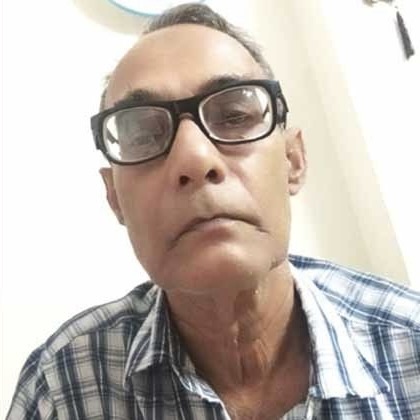
According to his testimony, on the night of 7 May 2018, several plain-clothes men arrived at his rented apartment in Dhaka and picked him up. Photo: Handout
In the ongoing trial concerning allegations of enforced disappearance carried out by Bangladesh’s military intelligence apparatus, yesterday, seventy-one-year-old Iqbal Chowdhury appeared as the fourth state witness for the prosecution. According to his testimony, on the night of 7 May 2018, around 11:00 pm, several plain-clothes men arrived at his rented apartment in Mohammadpur, Dhaka. They rang the doorbell and asked his wife whether Iqbal Chowdhury was at home. When he came forward and identified himself, the men claimed to be members of a law-enforcement agency and instructed him to accompany them to their “office” for questioning.
No warrant was presented, nor was the identity of the agency disclosed. When Chowdhury attempted to ask further questions, such as which force they belonged to and where they were taking him, he was rebuked and told he had no choice but to comply. He was escorted down the stairs from the fifth floor while his wife followed behind in distress.
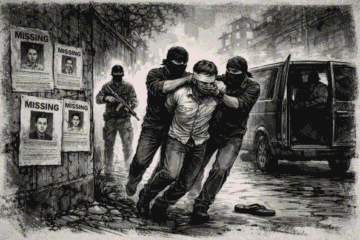
Outside, he saw a white microbus with black-tinted windows waiting nearby. As he resisted entering the vehicle, a firearm was pressed against his back and he was forcibly pushed inside. Once in the vehicle, his eyes were covered with cloth, a woolen cap was pulled over his head, and handcuffs were fastened around his wrists. During the journey, one of the men warned him that he must answer questions truthfully or he would be killed in a “crossfire” and his body disappeared.
Chowdhury’s testimony details how the rhythms of detention were structured through tightly controlled routines
After roughly twenty to thirty minutes of travel, he heard the sound of a gate opening and the vehicle entering what appeared to be a secured compound. Inside, he was removed from the vehicle and briefly questioned about his identity while another individual measured his blood pressure. Soon afterward his blindfold, cap, and handcuffs were removed. He was ordered to remove his clothes and was given a worn lungi and an old T-shirt to wear. He was then placed inside a small room approximately eight to ten feet in size.
The space itself, bare concrete walls without plaster, a small wooden cot, a greasy pillow, and a stained blanket, formed part of what he later described as an environment resembling a “living grave.” A single overhead light remained illuminated twenty-four hours a day, while a large industrial exhaust fan mounted on the wall generated constant noise. The room had a metal-barred door, followed by a wooden door that was kept shut. The combination of continuous artificial light and mechanical sound produced a sensory regime designed to isolate and disorient the detainee.
Chowdhury’s testimony details how the rhythms of detention were structured through tightly controlled routines. Guards periodically blindfolded and handcuffed him before escorting him to the bathroom, where he was permitted to brush his teeth and wash under supervision. He recalls hearing the dawn call to prayer from nearby mosques, which helped him infer the time of day. Meals were passed through a gap beneath the door, typically simple food such as two pieces of flatbread and fried potatoes. At intervals, he was escorted to another room, which he perceived as air-conditioned due to the cold temperature. There he was seated on a wooden stool while several individuals entered the room. From their voices, demeanour, and style of questioning, he inferred that they were military officers. The interrogations focused heavily on his online writings, his criticism of the Awami League government, his commentary on Indian political influence in Bangladesh, and his personal connections with officers in the military and police, relationships he explained were largely familial or social in nature.
The interrogations gradually escalated into systematic physical abuse. On one occasion, an interrogator addressed him with derision, emphasising that he was a freedom fighter who had trained in India during the 1971 war and questioning why he now criticised India. During this session he was beaten repeatedly with a thick stick on his knees, shins, and ankles, causing severe swelling and pain. In another episode, clips were attached to his finger and ear and electric shocks were administered.
During one interrogation he heard a voice speaking in Hindi remark that he was a “dangerous man” and highly intelligent
As a result, part of the fingernail on his ring finger was permanently damaged and he experienced lasting numbness in his hand. During one interrogation he heard a voice speaking in Hindi remark that he was a “dangerous man” and highly intelligent, an observation that led him to suspect the presence of a foreign individual, possibly an Indian interlocutor, among those involved in the interrogation process.
Beyond the immediate violence of interrogation, Chowdhury’s testimony also documents the temporal disorientation characteristic of prolonged secret detention. Months passed in isolation, marked only by faint auditory cues from the outside world, such as the sounds of trains, helicopters, and aircraft overhead. This suggested to him that the facility might be located near the Dhaka Cantonment area. In another cell where he was later held, he observed desperate inscriptions scratched into the walls with pieces of brick: fragments of messages left by other detainees pleading that someone who saw the writings should call a particular phone number and inform their family that they had been detained.
On one occasion he briefly saw a familiar military officer, Lieutenant Colonel Hasinur Rahman, while being escorted to the bathroom; both men pretended not to recognise each other. Years later, after his release, a conversation through Facebook Messenger with that officer confirmed to him that he had indeed been held in a Joint Interrogation Cell (JIC) operated under the authority of the Directorate General of Forces Intelligence (DGFI).
His captivity lasted nearly eleven months. During that time he remained cut off from family and the outside world. He later learned that two of his sisters died while he was missing, and his younger brother died shortly before his release. Eventually, one of the interrogators informed him that orders had come “from above” permitting his release. Two days later, he was blindfolded again, driven for approximately twenty minutes, and abandoned near Mohammadpur. When the blindfold and handcuffs were removed he discovered he was near Shia Mosque Road and walked home. It was late at night on 25 April 2019.
In the aftermath of his release, Chowdhury remained largely confined to his home for nearly a year out of fear. His testimony before investigators thus carries a dual significance: it is both an account of personal suffering and a documentary trace of a broader system of clandestine detention. By naming senior officials—including the then prime minister, senior military intelligence leadership, and officers associated with the facility—he frames his disappearance not as an isolated incident but as part of a structured apparatus of coercive governance. In this sense, his testimony provides a crucial ethnographic archive of disappearance: revealing how the machinery of security operates through secrecy, intimidation, and the systematic erasure of legal visibility.
The testimony of Iqbal chowdhury sparked a series of unsettling questions about the underlying rationalities of the security regime itself. If the Joint Interrogation Cell (JIC) functioned as a site ostensibly dedicated to safeguarding national security, why did the interrogations repeatedly circle back to the “Indian question” with such intensity? Chowdhury’s account suggests that the interrogators were less concerned with conventional security threats than with disciplining particular forms of political speech, especially criticism of India and of the Bangladeshi government’s relationship with it.
The repeated emphasis on his Facebook writings about Indian influence, the interrogation framed around his status as a freedom fighter who had trained in India during 1971, and the moment when an interrogator spoke in Hindi all reveal a curious paradox, that an intelligence apparatus formally tasked with protecting the sovereignty of the state appeared deeply preoccupied with policing discourse about a neighbouring power.
The testimony raises broader questions about how security institutions define loyalty, dissent, and geopolitical alignment
In this sense, the testimony raises broader questions about how security institutions define loyalty, dissent, and geopolitical alignment. Rather than merely identifying threats to the state, the interrogations seemed to enforce a particular geopolitical sensibility, one in which criticism of India was treated as suspicious, even subversive. This dynamic invites deeper scrutiny into how national security, regional alliances, and the management of political dissent become entangled within the clandestine spaces of interrogation.
A second question emerging from Chowdhury’s testimony concerns the figure of the detainee himself. Why would a seventy-year-old veteran and small-scale political commentator, someone who neither commanded an organisation nor possessed the capacity to mobilise followers or orchestrate violent networks, become the object of such sustained intelligence attention in Bangladesh?
This detention points to a shift in how contemporary security regimes conceptualise threat. Rather than targeting only organisational infrastructures of violence, regimes of counterinsurgency increasingly operate through the management of discourse, affect, and symbolic authority. Chowdhury’s profile as an elderly freedom fighter, a locally respected figure, and an outspoken critic on social media carried a particular moral weight within Bangladesh’s political imagination.
His words did not mobilise militias, but they circulated narratives that contested the dominant geopolitical alignment of the state. In this sense, what the intelligence apparatus appeared to confront was not an operational network but a discursive one, the capacity of speech, memory, and historical legitimacy to unsettle official narratives of sovereignty and alliance. The detention thus reveals how security institutions often act preemptively against figures who embody alternative moral claims to the nation. From this perspective, Chowdhury’s disappearance illustrates how authoritarian security regimes expand their field of intervention beyond armed actors to encompass symbolic critics whose narratives threaten to disrupt the ideological coherence of the state.
A third question raised by Chowdhury’s testimony concerns the peculiar workings of Bengali nationalism within the architecture of secret detention. Throughout his captivity, he recalls that on notable national days, i.e., 16 December (Victory Day) and 14 April (Pohela Boishakh), he was unexpectedly served elaborate meals, including polao, beef, sweets, or fish and seasonal fruits. These gestures stood in stark contrast to the otherwise minimal and punitive conditions of disappearance.
Yet these moments of ceremonial generosity occurred precisely while he was being interrogated and punished as an “anti-national” figure for criticising the government and questioning Indian influence in Bangladesh. The contradiction exposes a deeper tension embedded within contemporary state narratives of Bengali nationalism. On the one hand, the detainee is disciplined as politically deviant, on the other, he is symbolically folded back into ritual performances of the nation through the observance of national days tied to the memory of 1971 and Bengali cultural identity. These moments expose how nationalism operates within carceral spaces not merely as ideology but as a disciplinary ritual, one that both reaffirms the moral authority of the state and subtly demands the detainee’s recognition of it. The offering of celebratory food thus appears less as compassion than as a subtle enactment of sovereign power, the same security apparatus that renders a citizen disappearable simultaneously orchestrates the rituals through which Bengali national belonging is affirmed
Finally, the limitation arising from Chowdhury’s testimony concerns accountability within the security apparatus itself. While his statement identifies senior political and intelligence officials as responsible for the system that enabled his disappearance, it simultaneously reveals the extensive involvement of ordinary soldiers, guards, and lower-ranking military staff who carried out the daily routines of confinement, interrogation, and torture. These were the individuals who blindfolded him, escorted him through the corridors, administered beatings, attached electric clips to his body, and enforced the regime of silence that structured his captivity. Yet within the current prosecutorial framework, these actors largely remain absent from the field of legal scrutiny; the focus of justice is directed primarily toward high-ranking commanders and senior officials.
This raises a difficult analytical and moral question: what happens to the forms of violence that are enacted through the bodies and actions of ordinary functionaries of the state? By concentrating responsibility at the level of command, the legal process risks rendering the everyday executors of violence invisible, even though it was through their hands that the machinery of disappearance operated. Chowdhury’s testimony therefore inadvertently exposes a structural tension within transitional justice itself, between the juridical desire to establish command responsibility at the top and the unresolved question of how to account for the dispersed, routine participation of lower-ranking personnel who materially enacted the violence.